In high-demand industrial environments, one of the biggest challenges at the end of the line is maintaining flow stability without compromising speed. This is where a case packing and palletizing system for flexible packaging comes into play—designed to adapt to products that don’t always behave predictably.
Unlike more rigid formats, flexible packaging—such as pillow bags, doypacks or flowpacks—tends to deform, shift, and react differently depending on the product, fill level, or even temperature.
That’s why having a well-designed system is no longer just an operational improvement—it becomes a key productivity driver, ensuring continuous flow, minimizing interruptions, and maintaining consistent performance across the line.
The real challenge: controlling instability
In many production lines, the manufacturing process is already fully optimized. However, bottlenecks often appear at the end of the line.
Why?
Because flexible packaging:
- Does not maintain a consistent geometry
- Is difficult to position accurately
- Can create irregular accumulations
- Requires gentle handling to avoid deformation
This leads to stoppages, rejects, or efficiency losses if the system is not properly designed.
The conclusion is clear: a fast line does not guarantee efficient production if the end-of-line is not aligned with that speed.
The key: system engineering, not just machinery
A common mistake is to approach case packing and palletizing as separate processes. In reality, they must be designed as a fully integrated system.
An efficient approach to case packing and palletizing system for flexible packaging should include:
- Product flow control from the packaging machine output
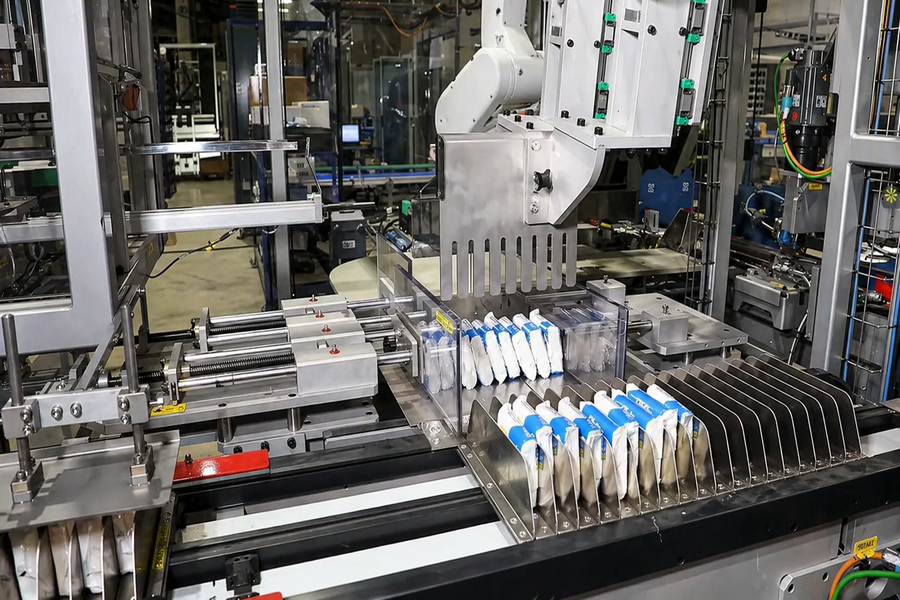
- Grouping systems adapted to the behavior of the product
- Specific handling technologies (vacuum, grippers, Delta robots)
- Full synchronization between case packing and palletizing
- Layout design that prevents accumulation or micro-stoppages
This is where engineering makes the difference.
It’s not just about moving products—it’s about ensuring that every stage of the process operates with stability.
Technologies that make the difference
Depending on the type of packaging and production speed, different technologies can optimize the process:
1. High-speed Pick & Place systems
Ideal for high-volume lines, enabling precise and repeatable handling of flexible packaging.
What is a pick and place system?
2. Delta robots
Especially effective for lightweight products, combining speed with gentle handling.
3. Intelligent grouping systems
Before case packing, proper product organization is essential to avoid misalignment.
4. Adaptive case packing
Capable of adjusting to multiple formats and configurations without complex changeovers.
5. Robotic palletizing
Enables different palletizing patterns while ensuring load stability, even with unstable products.
Stability in action
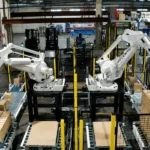
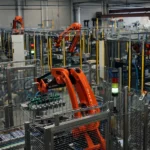
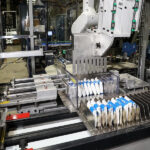
In the video accompanying this article, you can see how a complete case packing and palletizing system for flexible packaging operates continuously and in full synchronization.
👉 From product infeed to final pallet output, every stage is designed to avoid interruptions.
Key highlights include:
- Continuous flow without uncontrolled accumulation
- Precise handling of flexible packaging without deformation
- Smooth transition between case packing and palletizing
- High speed maintained without loss of control
This type of solution proves that performance and stability can go hand in hand—even in complex applications.
Real benefits on the production floor
Implementing an optimized case packing and palletizing system for flexible packaging has a direct impact on operations:
Higher overall efficiency
Micro-stoppages are eliminated, maintaining production rhythm.
Reduced errors
Less product misplacement or damage.
Operational flexibility
Ability to handle multiple formats and SKUs.
Better return on investment
A stable line reduces hidden costs and improves long-term productivity.
Scalability
The system can evolve according to future needs.

Beyond speed: designing for stability
In the industrial sector, there is often a tendency to prioritize speed as the main performance indicator. However, when working with flexible packaging, flow stability is just as important—if not more.
A fast line that stops frequently is a costly line.
That’s why the approach must change:
It’s not about going faster—it’s about maintaining flow without interruptions.
What defines a truly efficient system
Case packing and palletizing for flexible packaging requires a specific approach, based on product understanding and full system design.
Choosing a machine is not enough. What’s needed is a complete solution that ensures:
- control
- synchronization
- stability
At Xolertic, this approach is part of the DNA of every project: we design end-of-line solutions that not only work, but sustain performance over time.
If you want to analyze your line and identify real improvement opportunities, contact our team—we’ll review your case with no obligation.