In many industrial plants, the end of the line is often overlooked. For years, the focus tends to remain on the core production process: manufacturing, filling, processing. However, there comes a point when a key question arises: when to automate the end of the line to prevent it from becoming a bottleneck.
The decision is not always obvious. It is not simply about adding a robot or installing an automatic case packer, but about analyzing whether the current state of the end of the line is limiting growth, efficiency, or profitability. Identifying the right signals is the first step toward making a strategic decision.
Signal 1: The end of the line is the main bottleneck
If production capacity could increase, but case packing or palletizing cannot absorb additional volume, this is a clear sign. Many companies realize when to automate the end of the line precisely when the rest of the plant is already optimized, yet the final stage remains manual or semi-automatic.
The result often includes:
- Product accumulation
- Intermittent stoppages
- Staff overload
- Loss of overall efficiency
Tip: Analyze the OEE of the end of the line independently. If it is significantly lower than the rest of the process, it is time to evaluate automation solutions.
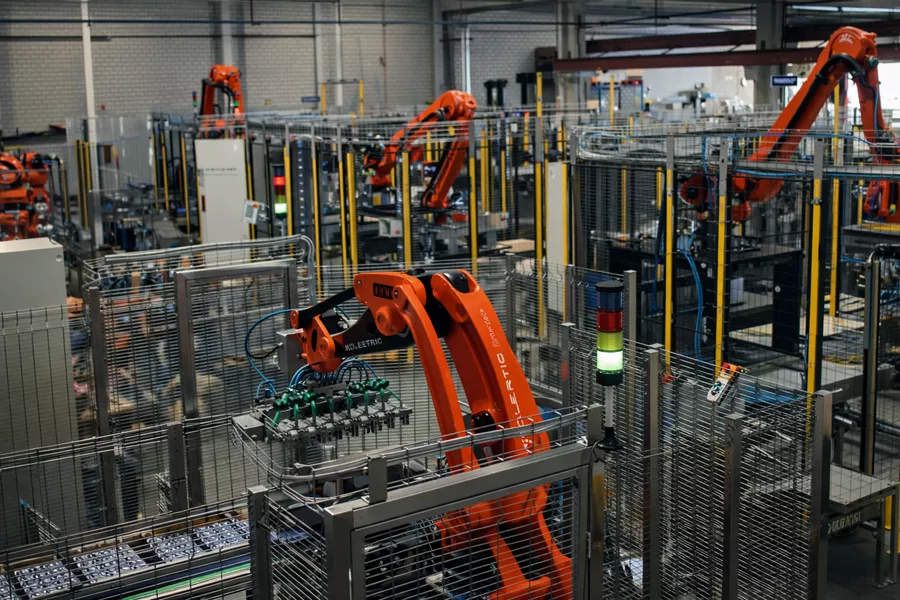
Automatic case packing: the key to optimizing the end of the line in the food industry
Signal 2: High dependency on labor
Manual palletizing and case packing involve repetitive and physically demanding tasks. Beyond ergonomic impact, there is also a strong dependency on workforce availability.
If your plant experiences:
- High employee turnover
- Difficulty covering shifts
- Increasing labor costs
- Variability in pallet quality
This is a clear indicator that you should consider when to automate the end of the line to reduce dependency and stabilize operations.
Tip: Calculate the true annual cost of personnel dedicated exclusively to repetitive end-of-line tasks. Comparing this with an automation investment can be eye-opening.
Signal 3: Increased SKUs and frequent format changes
Today’s industry operates with multiple SKUs, constant product launches, and packaging changes. When format changes slow down the end of the line or generate errors, this is another clear sign.
Understanding when to automate the end of the line also means anticipating future complexity. Well-designed automated systems can manage different palletizing patterns and case packing configurations quickly and accurately.
Tip: If format changes require more than 15–20 minutes of frequent adjustment per shift, flexible automation can provide a competitive advantage.
Signal 4: Recurring pallet quality or stability issues
A poorly formed pallet can cause:
- Logistics incidents
- Transportation damage
- Warehouse rejections
- Brand image issues
If product stability depends too heavily on the operator, it is time to evaluate when to automate the end of the line to ensure repeatability and precision.
Tip: Analyze the percentage of logistics incidents related to palletizing. Even small percentages can have a significant cumulative impact.
Signal 5: Expected production growth
Many companies react once the problem already exists. However, one of the smartest decisions is to anticipate it. Understanding when to automate the end of the line also means planning for growth.
If you plan to:
- Increase production capacity
- Add additional shifts
- Enter new markets
- Launch new product lines
The end of the line must be sized for that future scenario.
Tip: Do not design automation based solely on your current situation, but on a 3–5 year projection.
Signal 6: Lack of data and control in the final stage
A manual end of the line makes it difficult to collect reliable data. Without accurate information on throughput, stoppages, or efficiency, optimization becomes challenging.
When asking yourself when to automate the end of the line, you should also consider digitalization. Automated systems allow data integration, performance monitoring, and decision-making based on real information.
Tip: If you cannot accurately measure palletizing or case packing performance, you are likely missing improvement opportunities.
Signal 7: Poor process integration
The end of the line is not an isolated system. It must integrate with case packing, internal conveying, labeling, and shipping. If frequent misalignments, unnecessary accumulations, or synchronization issues exist, it is time to analyze when to automate the end of the line from a global perspective.
Well-integrated automation does not only increase speed—it enhances stability.
Tip: Evaluate the entire flow, not just individual equipment. Sometimes the issue is not the palletizer, but the lack of integration.

How to approach the decision correctly
Knowing when to automate the end of the line does not mean acting impulsively. It requires technical and strategic analysis:
- Study of real production rates
- Evaluation of future projections
- Available space analysis
- Integration review with existing equipment
- Return on investment calculation
Automation must adapt to the product, the environment, and the company’s objectives. There are no universal solutions.
Automation as a strategic decision
The real question is not only when to automate the end of the line, but how to do it coherently and aligned with business growth.
At Xolertic, we understand that each plant has its own reality. That is why we analyze every project from the product perspective, the production environment, and future projections. Automation is not about installing a machine—it is about designing an integrated system that delivers stability, efficiency, and scalability.
The end of the line is the last point before the product reaches the market. If that stage is unstable, the entire chain is affected. Detecting the signals early allows you to turn it into a competitive advantage.
👉 If you are considering when to automate the end of the line in your plant, our team can help you analyze your current situation and determine the best solution for your production environment — with no obligation.