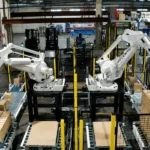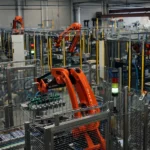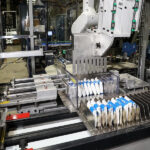
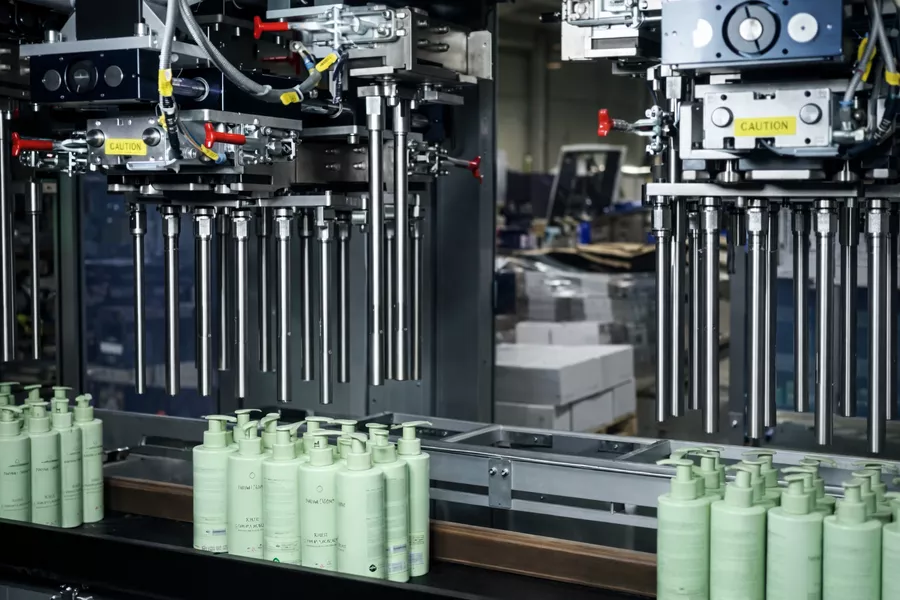
In an industrial environment where speed, precision, and flexibility are becoming increasingly demanding, the pick and place system has become one of the most widely used technologies in end-of-line automation.
Its ability to handle products quickly, accurately, and adaptively allows manufacturers to optimize case packing, grouping, and handling processes in industries with high production demands.
Especially in sectors such as food, beverages, cosmetics, pharma, and consumer goods — where multiple formats and high production rates coexist — implementing a pick and place system is no longer just an operational improvement: it is a strategic decision to maintain competitiveness.
Automatic case packing: the key to optimizing the end of the line in the food industry
What is a pick and place system?
A pick and place system is an automated solution designed to pick products from a specific position and place them in another in a controlled and repetitive way.
Although the concept may seem simple, behind this movement lies a combination of:
- robotics
- vision systems
- control systems
- dedicated handling tools
- synchronization with the entire production line
The objective is not simply to move products, but to do so while maintaining stability, speed, and precision, even in high-demand environments.
Today, pick and place systems are an essential part of many processes such as:
- automatic case packing
- line feeding
- product grouping
- palletizing
- handling of flexible or rigid packaging
Why the pick and place system is so important in the end-of-line
In many industrial plants, the end-of-line is where the biggest operational challenges appear.
Products arrive at high speed, formats change frequently, logistical complexity increases, and any small deviation can affect the overall performance of the line.
In this context, a pick and place system helps maintain a stable and automated production flow, reducing manual intervention and minimizing errors.
The main advantage of this type of technology is its adaptability.
Unlike more rigid or mechanical systems, pick and place solutions can handle different products and configurations with a high level of flexibility.
This is especially important in lines with:
- multiple SKUs
- frequent format changes
- delicate products
- high-speed requirements
How Xolertic approaches pick and place systems
At Xolertic, the approach is not simply about integrating robots into a line.
Each pick and place system is designed as part of a complete end-of-line solution, taking into account:
- product behavior
- required speed
- packaging type
- available space
- integration with case packing and palletizing systems
Depending on the application, Xolertic integrates different technologies such as:
- high-speed Delta robots
- 2-axis robots
- 4-axis spider systems
- collaborative COBOT solutions
- vision systems for position and orientation detection
As explained in Xolertic’s automatic case packing solutions, pick and place systems allow multi-picking applications, handling of multiple formats, and continuous synchronization with the production flow.
In addition, the modular design facilitates future expansions and adaptations as customer needs evolve.
Flexibility: the real competitive advantage
One of today’s biggest production challenges is variability.
Production lines must be capable of handling:
- different sizes
- multiple packaging types
- frequent changes
- new product references
This is why flexibility has become one of the most important factors when designing an end-of-line system.
And this is exactly where the pick and place system provides a clear competitive advantage.
Thanks to robotics and intelligent control systems, product handling can be quickly adapted without requiring complex modifications across the entire installation.
This allows manufacturers to:
- reduce changeover times
- improve productivity
- increase plant adaptability
- maintain stability even in complex lines

Common applications of pick and place systems
Today, pick and place systems have a wide range of applications within industrial automation.
At Xolertic, this technology is especially used for:
- flexible packaging case packing
- bottle and brick handling
- food product grouping
- multi-format solutions
- cosmetics and personal care lines
- complete end-of-line integration
In industries such as food or cosmetics, where product presentation and delicate handling are critical, system precision is essential to maintain product quality.
In addition, for high-speed applications, Delta robots and spider systems can achieve very high production rates while maintaining precision and repeatability.
Beyond product handling
A pick and place system is often associated only with moving products.
But in reality, its impact goes much further.
When properly integrated into the overall end-of-line system, this technology helps:
- stabilize production flow
- reduce downtime
- minimize errors
- optimize space
- improve operational efficiency
And above all, it allows manufacturers to design production lines prepared to grow and adapt to future changes.
Because automation is not just about adding robots.
It is about designing systems capable of maintaining performance over time.
The future of end-of-line automation is flexibility
Industrial automation is evolving toward increasingly flexible, intelligent, and adaptable models.
In this context, the pick and place system will continue to be one of the key technologies for meeting new market demands.
Especially in industries where product variability, speed, and efficiency are critical.
At Xolertic, this approach is part of every project: designing end-of-line solutions that combine robotics, engineering, and a global process vision to guarantee long-term stability and performance.
If you are considering implementing a pick and place system or improving your end-of-line, Xolertic can help you analyze your process and define the most suitable solution for your production.